
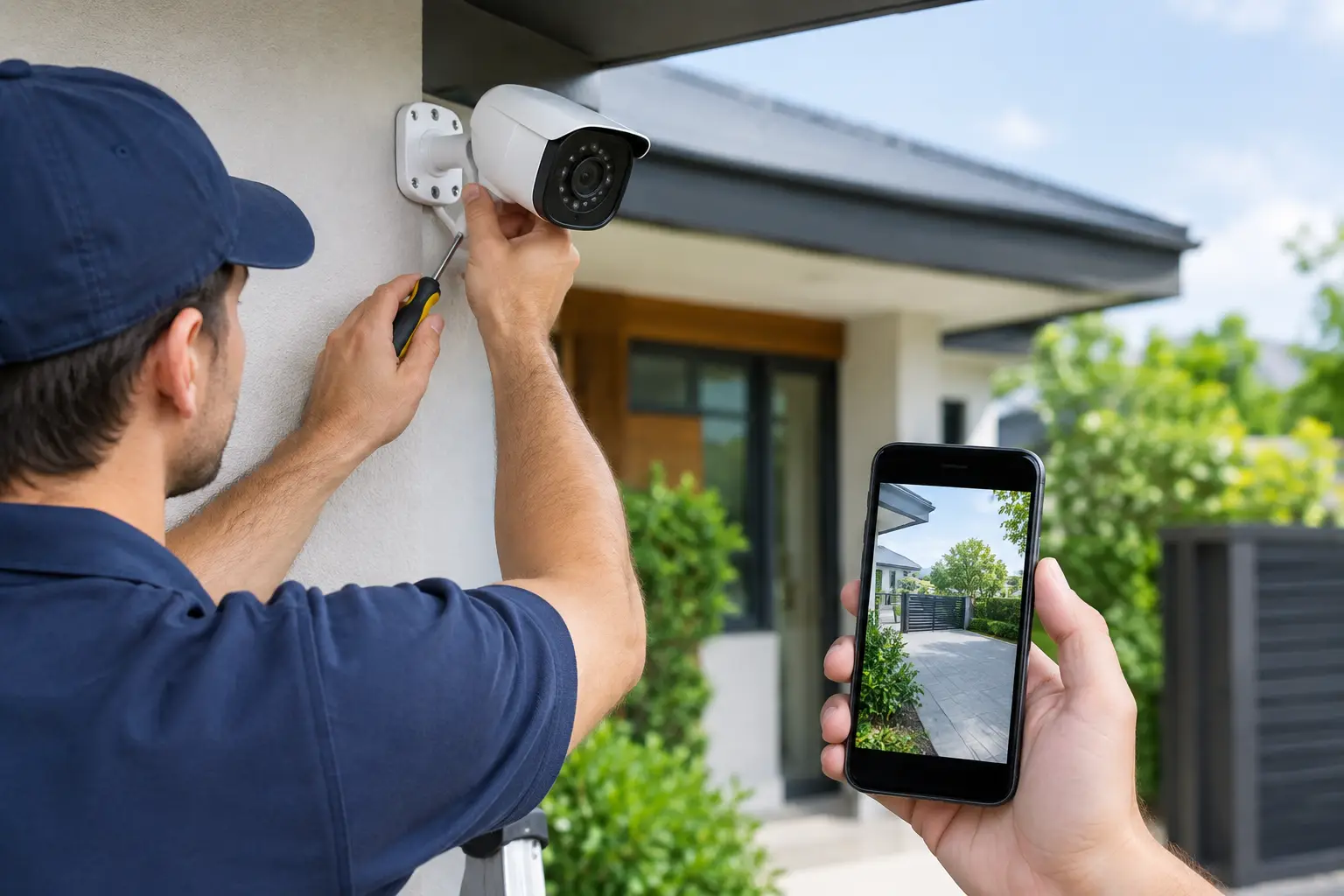
A CCTV installation should do more than put a camera above the front door. It should show a clear face at the gate, cover the drive without wasting a camera on the pavement, and give you footage you can actually find when you need it. Poor positioning, weak Wi-Fi and visible trailing cables are the usual reasons a system disappoints.
For most homes, the right answer is not the biggest box of cameras. It is a sensible plan based on your property, the areas you want to protect and how you want to view recordings. That is how you avoid paying for equipment that adds little value.
CCTV installation: get the coverage right first
Every property has different weak points. A terrace house may need clear coverage of the front entrance and rear access. A detached home may need cameras covering a driveway, side passage, garden gate and outbuildings. Landlords often need a straightforward system that protects shared entrances without creating a tangle of cables for tenants to deal with.
The first job is to walk around the property and decide what the cameras must prove. Seeing that somebody entered the drive is useful. Seeing their face clearly, the direction they travelled and the vehicle registration is far more useful. Camera height, angle, lighting and distance all affect that result.
A camera mounted too high gives a good view of heads and hats, but not faces. One pointed straight at a bright security light may produce glare rather than useful night footage. Placing it correctly at the start prevents the frustrating situation where a camera is technically working but misses the detail that matters.
Entrances, driveways and side access
Front doors and driveways are usually the priority. A video doorbell can identify callers at the door, while a fixed camera can cover the approach, parked vehicles and a wider section of the drive. These do different jobs, so it often makes sense to use both rather than expect one device to cover everything.
Side passages and rear gates deserve attention too. They are common access routes and are often poorly lit. A properly selected camera with effective infrared night vision can cover these areas without leaving a bright floodlight on all night.
Garden cameras are useful where there is a shed, workshop, expensive tools or a rear boundary with easy access. They should be aimed at your own land as far as practical. Domestic CCTV needs to be used responsibly, particularly if it records a neighbour's garden, a shared path or a public road.
Wired or wireless CCTV?
This is one of the first questions homeowners ask, and the honest answer is that it depends on the building and the result you expect.
Wireless cameras can be a good fit for a small property, a rented home or an area where running a cable would be disruptive. They are quick to place and can be viewed through an app. But wireless does not mean maintenance-free. The signal must travel through walls, insulation and other wireless devices, and battery models need charging. If the Wi-Fi is poor at the far end of the garden, the camera may be poor there too.
A wired system is usually the better long-term choice for permanent coverage. Cameras can be connected back to a recorder using data cable, giving a stable connection and continuous recording without relying on a battery. Cabling takes more planning, but it can be routed neatly through lofts, voids and discreet external routes so the finished job looks like part of the house rather than an afterthought.
There is also a middle ground. A Wi-Fi camera may work very well if the wireless network has been improved with a properly positioned access point. The important thing is to test the signal where the camera will sit, not assume it will be fine because your phone works by the back door.
Choose cameras for evidence, not marketing numbers
Camera specifications can be confusing. Higher resolution can help, but it is not the only thing that matters. A high-resolution camera aimed too wide may still not provide enough detail to identify someone at the end of a long drive.
The useful questions are simpler. Can it cover the distance involved? Is night footage clear at that location? Does it cope with a bright doorway or vehicle headlights? Can you view live footage and recordings easily from your phone? And how long do you want recordings kept?
A recorder-based system stores footage locally, commonly on a hard drive, and can provide reliable continuous recording. App-based cloud cameras can be convenient, though they may involve subscriptions and rely more heavily on a good internet connection. Neither is automatically better. For a homeowner wanting dependable coverage of several cameras, local recording is often the practical option. For one entrance camera and alerts on a phone, a cloud-based device may be all that is needed.
Motion alerts also need setting up properly. If every passing car, tree branch and neighbourhood cat triggers a notification, most people turn the alerts off within a week. Detection zones, sensitivity settings and person or vehicle filtering can make notifications useful instead of irritating.
What a tidy CCTV installation involves
A professional installation is as much about the parts you do not see as the cameras on the wall. Cable routes should be secure, weatherproof where external, and planned to avoid unnecessary drilling or obvious loops of wire. External connections need proper protection from rain and moisture. Indoor equipment needs a sensible location with ventilation, access to power and a stable network connection.
The engineer should also consider future access. A recorder hidden behind a heavy cabinet or a camera fixed where it cannot be safely serviced is not a good long-term plan. Work should be neat, but it should also be maintainable.
Once fitted, each camera needs testing in daylight and, where possible, after dark. The image should be checked on the recorder and the mobile app. Recording playback matters just as much as live viewing. There is little point having a sharp live image if footage cannot be retrieved when you need it.
At Speedy Aerials, the approach is straightforward: assess the property, explain the practical options, fit only what is needed, then test the whole system before leaving. There is no reason to fill a house with cameras if two or three well-positioned units will do the job better.
Think about the system around the cameras
CCTV is strongest when it forms part of a sensible home-security setup. A camera can show what happened. A wired video doorbell can let you speak to somebody at the door. An intruder alarm can alert you to an entry attempt, while external lighting can improve the image around entrances and access routes.
That does not mean every home needs every product. A compact flat may only need a doorbell camera and one view of the communal approach, subject to the property arrangements. A larger family home with a detached garage may benefit from wider coverage, an alarm and a better Wi-Fi network. Good advice starts with the problem, not a sales target.
If you are renovating, laying new flooring or having other electrical work done, it is worth planning CCTV cabling early. Running cable while routes are accessible is usually tidier and less disruptive than trying to conceal everything later.
Common CCTV questions
Can I view my cameras when I am away from home?
Yes, provided the system is connected to your home network and set up for remote access. You can normally view live cameras, receive alerts and play back recordings through an app. The quality of remote viewing depends on your broadband upload speed, so this should be checked where coverage is important.
Will cameras work in the dark?
Most modern CCTV cameras use infrared night vision. Results vary with camera position, distance and nearby lighting. A camera looking across a large unlit garden needs a different approach from one monitoring a front doorstep under a porch light.
Do I need permission to install CCTV?
For a typical owner-occupied home, cameras covering your own property do not usually need planning permission. There can be exceptions for listed buildings, conservation areas and certain mounting locations. If your cameras capture areas beyond your boundary, you should take reasonable steps to respect privacy and follow data-protection guidance.
Can an existing system be repaired or upgraded?
Often, yes. Faults may come down to a failed power supply, damaged cable, hard drive issue, poor camera connection or network problem. In some cases, existing cable can be reused for newer cameras. A proper diagnosis is better than replacing the whole system on guesswork.
The best CCTV system is the one you can rely on without thinking about it: clear footage, sensible alerts, tidy cabling and a setup that suits the way your household actually lives. If you are unsure where to start, begin with the entrances and access routes that matter most, then build from there.